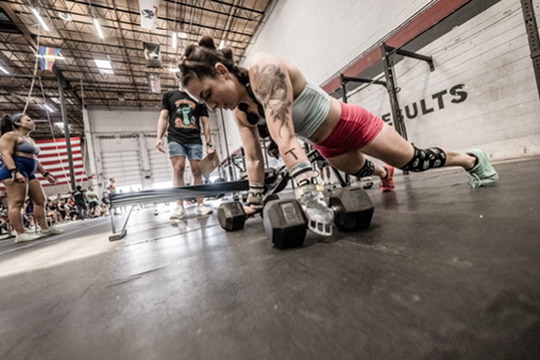
I’ve been competing for almost as long as I’ve been doing CrossFit. Granted, I originally started CrossFit with the goal of competing and eventually making it to the highest level of the sport. But over the years, through countless training sessions and competitions, I’ve come to realize that competing serves a purpose far greater than simply determining who’s the best.
And I think more people could benefit from experiencing it.
Competition Isn’t Just for Elite Athletes
Something that I think gets overlooked is that the majority of CrossFit competitions aren’t filled with elite athletes. They’re filled with everyday people. People who come into the gym, take a class for an hour, three to five days per week, and then go about their lives.
I understand why this might be surprising.
CrossFit itself already has a reputation for being intense, intimidating, and reserved for the athletically gifted. Add the word competition to the conversation, and that intimidation seems to multiply.
People say things like:
- “I could never do that.”
- “I’m nowhere near in shape enough to compete.”
- “I need to get better before I even think about doing something like that.”
But here’s the thing: You don’t have to be an elite athlete to compete. You just have to be willing to challenge yourself.
Over the years, having coached at several different gyms and worked with athletes of all experience levels, I’ve noticed something interesting. There will always be people who tell me they “just do CrossFit for fun” or that they “aren’t competitive.” And ironically, some of those individuals end up having the most competitive spirit of anyone in the gym.
More often than not, I’ve found that their hesitation isn’t necessarily a lack of interest in competing. It’s a preconceived idea of what someone needs to be capable of before they’re able to compete. They think they need to be able to do muscle-ups, lift a certain amount of weight, or perform every movement as prescribed. But that couldn’t be further from the truth.
Most local CrossFit competitions offer different divisions, including beginner, scaled, intermediate, and RX. The purpose of these divisions is to allow athletes with different abilities and experience levels to participate in an appropriately challenging environment.
You don’t need to be the strongest, fastest, or most skilled person in your gym to compete. In fact, I’d argue that some of the people who have the most to gain from competing are the ones who don’t consider themselves competitive athletes at all.
Competition Starts With Yourself
Since opening CrossFit Renegade in February, I’ve made an effort to encourage our members to embrace competition. Now, that doesn’t mean I’m pushing everyone to qualify for the CrossFit Games. Actually, the first person I encourage every member to compete against is themselves.
- How many more calories can you accumulate on the Echo Bike compared to when you first joined 30 days ago?
- How much has your overhead press improved after six months of consistent training?
- Can you complete a workout with less rest than you needed three months ago?
- Can you perform a movement today that you couldn’t do when you started?
These are all forms of competition, and I’d argue they’re some of the most important ones. They provide objective ways to measure progress. Rather than relying solely on how fit you feel, you have actual evidence that the work you’re putting in is paying off.
Of course, when someone is new to CrossFit, my priority is making sure they develop a solid foundation first. I want them to develop the proper mechanics, and be able to perform them consistently, before adding intensity.
And when I say I encourage members to compete, I want to make something very clear: nobody at CrossFit Renegade is pressured or made to feel less than because they choose not to compete. Some people genuinely have no interest in participating in a competition, and that’s perfectly fine. Both types of individuals are equally welcome here.
The purpose of this post isn’t to convince everyone that they have to compete. It’s to explain the benefits I’ve personally experienced and witnessed in others, and why I believe almost every healthy individual could gain something valuable from putting themselves in a competitive environment.
1. Competition Teaches You How to Handle Adversity
Of all the competitions I’ve participated in, maybe only 1 or 2 have gone exactly as I expected. There’s almost always something.
A workout doesn’t play to your strengths. You misjudge your pace. You get several no-reps from your judge. The equipment feels different from what you’re used to. You make a mistake that costs you valuable time. Suddenly, the plan you spent weeks preparing goes out the window.
And now you have a choice.
You can become frustrated, panic, and let that mistake dictate the rest of your performance. Or you can accept what’s happened, reassess the situation, and figure out how to move forward.
That ability to adapt when things don’t go according to plan is one of the most valuable lessons competition can teach you.
It’s easy to stay composed when everything is going your way. It’s much harder to do so when you’re physically exhausted, mentally frustrated, and under pressure. Competition gives you opportunities to practice that skill in a controlled environment.
You learn to focus on what you can control rather than dwelling on what you can’t. You learn how to make decisions when you’re tired, how to recover from mistakes without letting them snowball, and how to continue putting forth effort even when the outcome you wanted is no longer realistic.
And those lessons don’t disappear when you leave the competition floor.
Life is full of unexpected obstacles, setbacks, and situations that don’t unfold the way we planned. Whether it’s something at work, a personal challenge, or a goal that takes longer to achieve than expected, the ability to remain composed and keep moving forward is invaluable.
A CrossFit competition isn’t going to magically make you resilient. But repeatedly exposing yourself to manageable challenges, experiencing setbacks, and learning to work through them gives you an opportunity to develop that resilience.
Sometimes, the most valuable thing you walk away with isn’t a medal or a placement. It’s the knowledge that things went wrong, you figured it out, and you kept going anyway.
2. Competition Exposes Your Strengths, Weaknesses, and Blind Spots
One of the great things about CrossFit is that it’s measurable. We can track how much weight we lift, how quickly we complete workouts, and how our performance changes over time. But there’s also something to be said about stepping outside the environment where you train every day and seeing how you stack up against people you don’t normally train with.
It’s easy to become a big fish in a little pond. Maybe you’re consistently one of the strongest people in your class. Maybe you almost always finish workouts first. Or maybe you’ve become so comfortable with your usual training routine that you haven’t really challenged yourself in a while.
Then you compete.
Suddenly, you’re surrounded by people you’ve never trained with, some of whom might be significantly stronger, faster, or more skilled than you. And that’s a good thing. Competition has a way of exposing weaknesses that might otherwise go unnoticed.
Maybe your strength is excellent, but your cardiovascular endurance needs work. Maybe you’re great at gymnastics movements when you’re fresh, but struggle to perform them under fatigue. Or maybe you’re physically capable of doing everything in a workout, but your pacing and strategy need improvement.
These realizations give you valuable information about where to direct your training.
On the other hand, you might discover strengths you didn’t even know you had. Maybe you perform exceptionally well under pressure. Maybe you’re more capable of pushing through discomfort than you thought. Maybe you end up outperforming people you initially assumed were much fitter than you.
Competition provides perspective.
And I think perspective is important for everyone, regardless of ability. For those who are already confident in their fitness, it can be a humbling reminder that there’s always room to improve. For those who underestimate themselves, it can be proof that they’re far more capable than they give themselves credit for. Either way, you walk away knowing a little more about yourself than you did before.
3. Competition Teaches You to Get Comfortable Being Uncomfortable
For a lot of people, the idea of competing is intimidating. Not necessarily because of the physical demands, but because of the mental ones.
There’s a certain vulnerability that comes with putting yourself out there. When you sign up for a competition, you’re voluntarily entering an environment where your abilities will be tested, your performance will be visible, and the outcome is uncertain.
You might not perform as well as you hoped. You might finish last. You might fail a lift in front of a crowd of people. You might discover that you aren’t quite as good at something as you thought you were. And for many people, that’s uncomfortable because it puts their ego at risk.
But I think there’s tremendous value in willingly placing yourself in situations where success isn’t guaranteed. We spend a lot of our lives trying to avoid discomfort, embarrassment, and failure. It’s human nature. We generally prefer situations where we’re confident in our abilities and have some control over the outcome. The problem is that when we only participate in things we already know we’re good at, we limit our opportunities for growth.
There’s a difference between being incapable of doing something and being uncomfortable with the possibility that you might not do it well.
Competition forces you to confront that distinction.
You learn that feeling nervous doesn’t mean you’re unprepared. You learn that being afraid of failure doesn’t mean you shouldn’t try. And perhaps most importantly, you learn that your value as a person isn’t determined by how you perform.
You can prepare diligently, give something your absolute best effort, and still not achieve the outcome you wanted. And that’s okay. Learning to separate your self-worth from your performance is an important skill, both in and outside of the gym.
There’s also something empowering about doing something that genuinely makes you nervous. Think about the first time you tried a difficult movement, walked into a new gym, or did something completely outside your comfort zone. Chances are, the anticipation was worse than the experience itself. And afterward, whether you succeeded or not, you probably felt a little more confident in your ability to handle similar situations.
Confidence isn’t always something you develop before doing something difficult. Sometimes, it’s something you earn by doing the difficult thing despite being nervous.
That confidence can carry into other areas of your life. You don’t have to win to grow from the experience. Sometimes, just having the courage to show up is a win in itself.
4. Competition Is Fun, and It Builds Community
I’ve spent a lot of time talking about the mental benefits of competing, but there’s another reason I encourage it.
It’s genuinely fun.
There’s something special about spending weeks preparing for an event, showing up on competition day, and getting to see what you’re capable of.
You get to put all those hours in the gym to the test. The early mornings, the workouts you didn’t feel like doing, the skills you’ve been practicing, and the small improvements you’ve been making finally come together in a new environment. And regardless of where you place, there’s a real sense of accomplishment that comes from following through on something you’ve worked toward.
CrossFit competitions also have a unique community aspect. Many local competitions offer two-, three-, or four-person team divisions, making them a great introduction for people who might be hesitant to compete individually.
And competing on a team brings an entirely different set of benefits. When you’re part of a team, the focus shifts away from your individual performance and toward what you can accomplish together. You have to communicate, strategize, recognize each other’s strengths and weaknesses, and learn how to work together when things get difficult. Maybe one teammate is an excellent lifter but struggles with endurance. Another might be great at gymnastics but less confident with heavier weights. Instead of viewing those differences as shortcomings, you learn to use them to your advantage.
You rely on each other.
And perhaps more importantly, you become responsible for more than just yourself. There will be moments when your teammate is struggling and needs encouragement. There will be moments when you’re the one struggling and need someone else to pick you up. You learn how to support someone without becoming frustrated, how to communicate effectively under pressure, and how to celebrate someone else’s success just as enthusiastically as your own.
These are skills that extend well beyond fitness.
And there’s something about going through a difficult experience together that brings people closer. The shared nerves before the first workout, the encouragement from the sidelines, the excitement when someone hits a personal record, and the laughter afterward when everyone is exhausted.
Those are the things people remember.
Some of the best memories I’ve made through CrossFit haven’t come from winning competitions. They’ve come from the people I’ve competed alongside, the experiences we’ve shared, and the relationships built along the way.
Competition also allows members to see each other in a different light.
You might train next to someone several days a week, but watching them push through a difficult workout, overcome a fear, or accomplish something they’ve been working toward gives you a new appreciation for that person. And when other gym members come out just to cheer everyone on, even when they aren’t competing themselves, it reinforces something that I think makes CrossFit special.
We’re a community of people who genuinely want to see each other succeed.
Final Thoughts: You Don’t Have to Be the Best to Benefit From Competing
If there’s one thing I hope people take away from this post, it’s that competition isn’t reserved for the most talented athletes in the room. You don’t have to be able to do muscle-ups, lift hundreds of pounds, or finish at the top of the leaderboard to have a worthwhile experience. You don’t even have to consider yourself a competitive person.
I think too many people approach competition with the mindset that they need to reach a certain level of fitness before they’re ready. But the truth is, there will always be something you could be better at. There will always be someone stronger, faster, or more skilled. And if you wait until you feel completely ready, there’s a good chance you’ll never take that first step.
Of course, readiness matters. You should have the necessary movement proficiency, an appropriate fitness foundation, and choose a division that matches your abilities. But once those things are in place, you don’t need to be exceptional to participate. You just need to be willing to try.
At CrossFit Renegade, I want to build a community of people who aren’t afraid to challenge themselves. People who recognize that progress isn’t always measured by winning, and that there’s value in doing difficult things even when the outcome is uncertain.
Whether that means signing up for your first local competition, participating in an in-house event, or simply trying to beat your previous score on a workout, the principle is the same.
Challenge yourself. Learn something. Grow from the experience.
Because ultimately, the greatest benefit of competition isn’t proving that you’re better than someone else. It’s discovering what you’re capable of, where you can improve, and who you can become through the process.
And I think that’s something worth competing for.
Mckenzie Cushard
CF-L3, NSCA-CPT, USAW-L2
Owner of CrossFit Renegade